Accident on I-5 in Stockton?What to Do
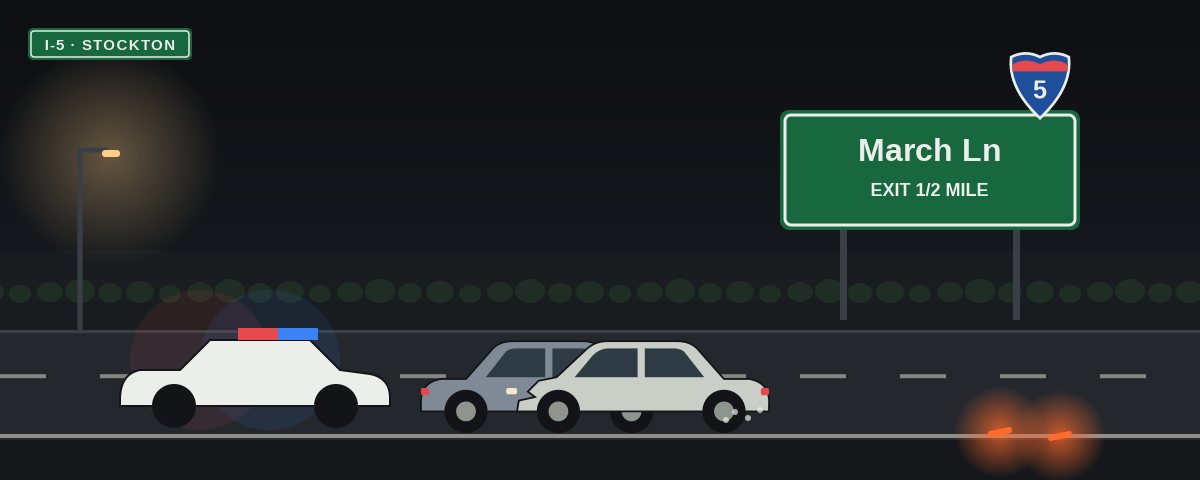
A crash on I-5 through Stockton happens fast and leaves you standing on a narrow shoulder with trucks passing a few feet away. Stockton’s freeways carry a lot of freight between the Port, the warehouses on Arch-Airport Road and the rest of the state. The order you do things in afterward matters for your safety first, and for your insurance claim second.
Here is what to do, in order, after an accident on I-5, Highway 99 or a Stockton street.
1. Check for injuries and call 911 if needed
Look after people before cars. If anyone is hurt, if a vehicle is on fire or leaking fuel, or if a car is stuck in a travel lane, call 911 right away. On the freeway, tell the dispatcher your direction of travel and the nearest exit, for example “northbound I-5, just past the March Lane exit.” On a city street, give the cross streets.
If nobody is hurt, you still want a report for anything beyond a small scrape. The California Highway Patrol handles freeway crashes. The Stockton Police Department usually handles crashes on city streets.
2. Get out of traffic
If both cars can still drive and nobody is hurt, move them onto the right shoulder or off at the next exit. Turn on your hazards. On I-5 and Highway 99 the shoulder is often narrow, and the safest place to stand is behind the guardrail, well away from the lanes. If the cars cannot be moved, stay buckled in with your hazards on until help arrives. Do not stand between your car and traffic.
At night or in tule fog, keep your parking lights on so other drivers can see you.
3. Document the scene before anything moves
Use your phone and take more photos than you think you need:
- Both vehicles from all four corners, plus close-ups of every damaged area
- License plates of every car involved
- The road: skid marks, debris, traffic signs, signals and lane markings
- The other driver’s license, registration and insurance card
- Anyone who saw it happen: names and phone numbers
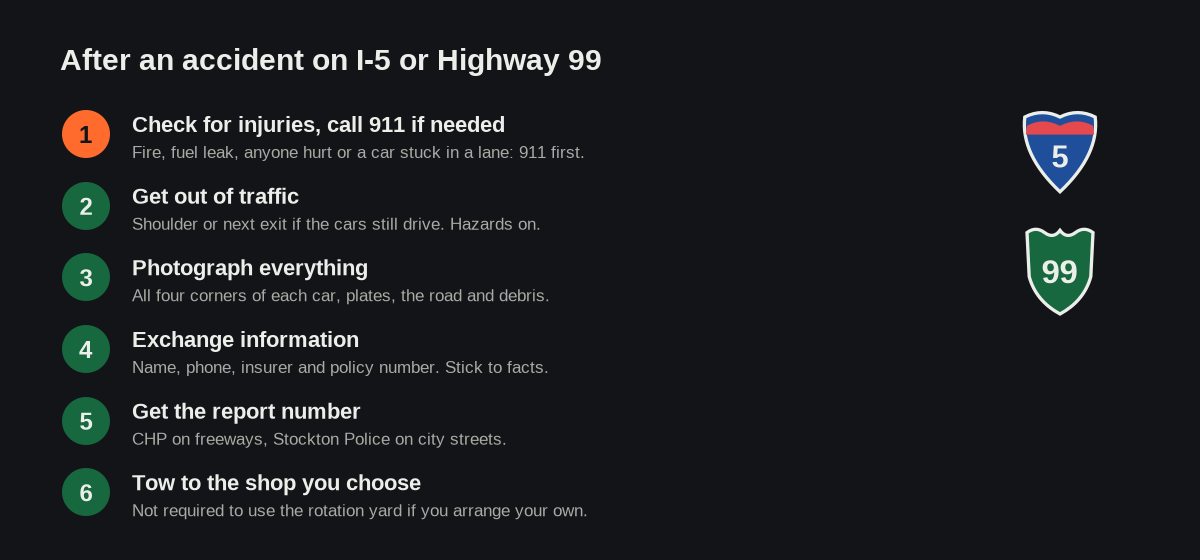
Exchange name, phone number, insurance company and policy number with the other driver. Stay calm and stick to facts. Do not apologize or agree about who caused it at the scene, because that is for the insurers and the report to sort out.
4. Get the report number
If CHP or police respond, ask the officer for the report number and the officer’s name before you leave. Your insurer will ask for it, and it is much harder to track down later.
California also has its own reporting rule. If anyone was injured, or the damage to any vehicle is more than $1,000, you must file an SR-1 form with the DMV within 10 days. This applies even if an officer wrote a report. Modern bumpers, sensors and headlights mean most crashes pass $1,000 quickly, so file it if in doubt.
5. Decide where the car goes
This is where many people lose money. If the officer on scene calls the next tow truck on their rotation list, usually because your car is blocking a lane or you cannot arrange your own tow, that truck takes your car. It may go to the operator’s storage yard, where daily storage fees start adding up.
If your car can be left safely on the shoulder for a short time and the officer agrees, you can usually arrange your own tow and choose where it goes:
- Your body shop, or one your insurer recommends. The choice is yours either way.
- Your home, if you need time to decide.
- A dealership, for newer cars or warranty work.
Call (209) 850-ROAD and give the dispatcher your location, the car and where it should go. You get the price and an arrival estimate on the phone before a truck is sent. Cars with collision damage often go on a flatbed, especially if a wheel is bent or the car will not roll.
If your car already went to a storage yard, move it once it is released. Every day there adds to the bill. Our guide to getting a towed car back in Stockton explains the release process, and we can handle the move from the yard to your shop.
6. Call your insurer the same day
Report the claim as soon as you are safe, even if the other driver was clearly at fault. Give them the report number, your photos and the other driver’s details. Keep every receipt for towing, storage and rides home. Collision coverage usually covers a reasonable tow to a repair shop, and the at-fault driver’s insurer often ends up covering it if fault is clear.
Where Stockton crashes tend to happen
Stockton sees collisions in a few places again and again. The short merges on the Crosstown Freeway (Highway 4) and the stop-and-go stretch of Highway 99 between Hammer Lane and Arch Road are common spots. So are I-5 near the Port and the Eight Mile Road interchange, where truck traffic is heavy. Winter tule fog adds chain-reaction crashes on both I-5 and Highway 99. In harvest season, slow farm equipment and double-trailer tomato trucks share the road with commuters, and the speed gap causes rear-end collisions.
None of this makes a crash less stressful, but knowing the steps keeps you safe and protects your claim. If you need a tow after an accident anywhere in San Joaquin County, see our accident towing page or call (209) 850-ROAD.