Car Overheating on Highway 99?Do This
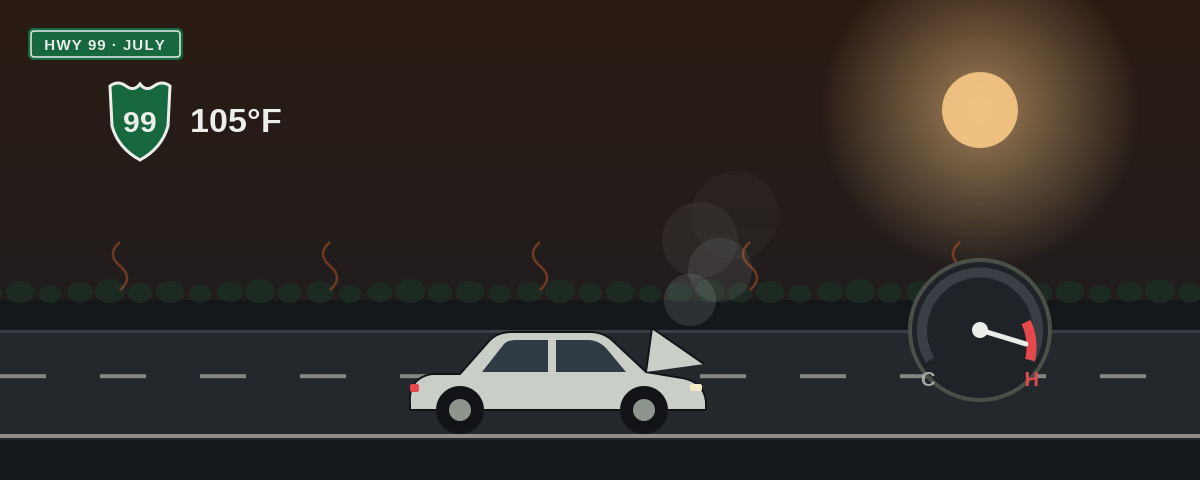
A Stockton summer is hard on cooling systems. Afternoons regularly pass 100 degrees, Highway 99 between Hammer Lane and Arch Road crawls at rush hour, and the climb over the Altamont on I-580 works an engine hard. If your temperature gauge starts climbing, what you do in the next two minutes decides whether this is a cheap fix or a ruined engine.
What to do the moment the gauge climbs
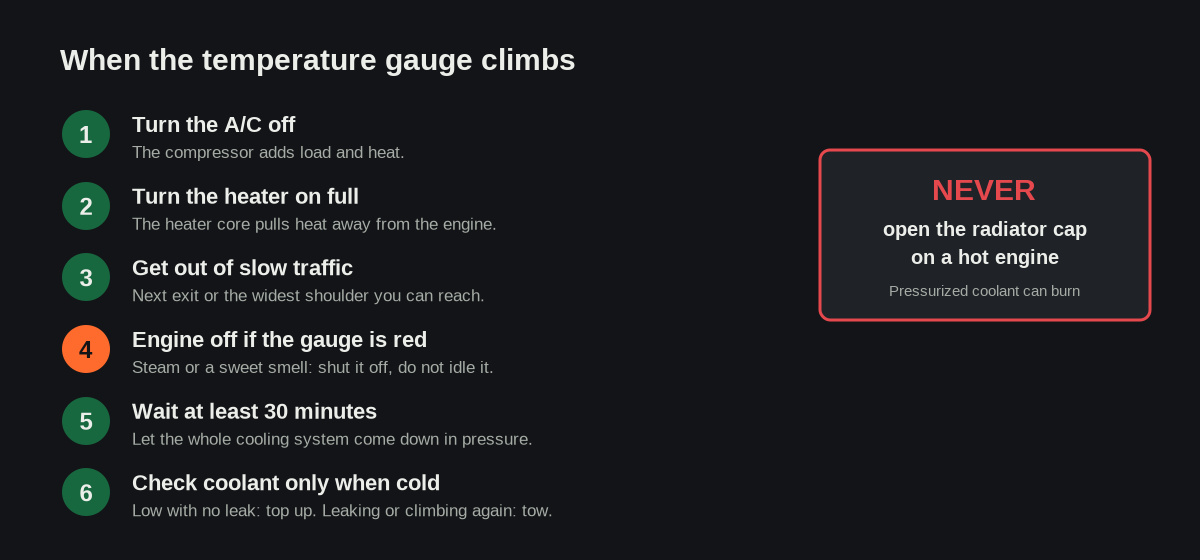
- Turn off the air conditioning. The compressor adds load and heat.
- Turn the heater on full, with the fan on high. It feels wrong on a 105-degree day, but the heater core is a small second radiator. It pulls heat away from the engine.
- Ease off and get out of traffic. Take the next exit or move onto the widest shoulder you can reach. Stop-and-go traffic is the worst place for an overheating car, because almost no air moves through the radiator.
- Turn the engine off once you are safely stopped. If the gauge is in the red, or you see steam or smell sweet coolant, do not idle it to “let it cool.” Shut it off.
What never to do
- Never open the radiator cap or the coolant reservoir while the engine is hot. The system is pressurized, and the coolant can spray out hot enough to cause serious burns. Wait at least 30 minutes before you touch either one.
- Do not pour cold water on a hot engine. Sudden cooling can crack metal parts.
- Do not keep driving with the gauge in the red. A few more miles can warp the cylinder head or blow the head gasket. Those repairs often cost more than an older car is worth.
After it cools: is it safe to drive?
Once the engine has been off for at least 30 minutes, open the hood and check the coolant reservoir. Here is a rough guide to what you might find:
- Coolant reservoir low, no visible leak: top it up with coolant, or plain water in an emergency. If the gauge stays normal, drive gently to a shop and have it checked.
- Coolant puddle under the car, a split hose or steam still coming from the engine bay: do not drive it. There is a leak that will empty the system again within minutes.
- Gauge climbs again within a mile or two: pull over, shut it off and call for a tow. The cause could be a failed water pump, a stuck thermostat or a broken cooling fan, and none of those fix themselves.
- Temperature warning plus a flashing check-engine light, rough running or white smoke from the exhaust: stop driving. Those can be signs of head gasket damage.
Why it happens so often here
Most overheating in the valley comes down to three things working together. Heat: the radiator can only shed so much heat when the outside air is already 100 degrees. Slow traffic: at a crawl on Highway 99 or the Crosstown, the radiator depends on the electric cooling fan, and a weak fan shows up exactly then. Load: a full car, a trailer or a long grade like the Altamont makes the engine produce more heat.
Older coolant makes all of it worse. Coolant breaks down over time, and a radiator partly clogged with scale cannot keep up on a hot day. If your car is more than a few years past its last coolant service, have the system checked before July.
Getting it to a shop
If the car cannot be driven, call (209) 850-ROAD. Give the dispatcher your location, the direction you were traveling and the nearest exit, then where the car should go. You get a price and an arrival estimate before a truck is sent. A car that overheated badly is often best moved on a flatbed, so the engine is not turned over again on the way.
If you broke down far from your usual mechanic, for example coming back over the Altamont from the Bay Area, ask the dispatcher to quote both a tow to a local shop and a long-distance tow home. Then decide with real numbers.
While you wait, stay off the travel lanes. Stand well behind the guardrail if you get out, and keep water with you: a valley shoulder in August is no place to wait without it. More on what to expect from a call is on our 24 hour towing page.